Music
Music Development Plan Summary
Overview
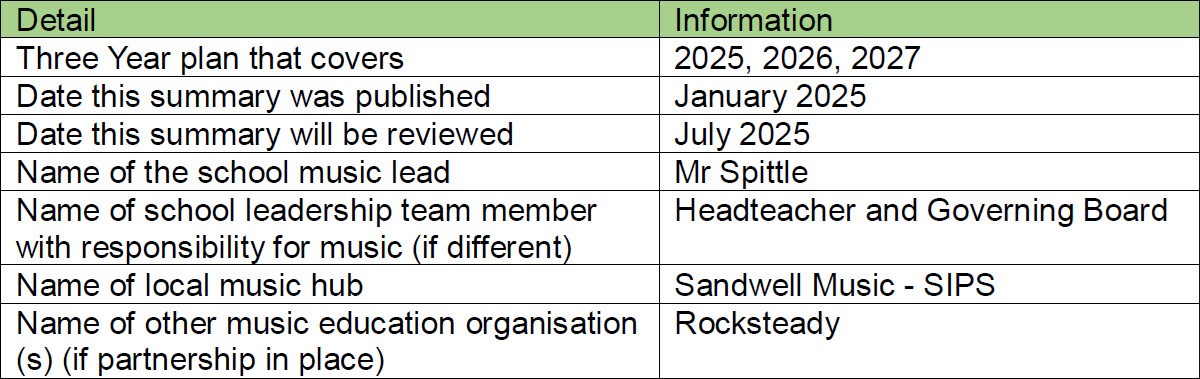
This document outlines how our school provides music education to all pupils through three key areas: curriculum music, co-curricular activities, and musical experiences. It also highlights our planned improvements for the coming years. Our aim is to help pupils and their parents or carers understand the music education opportunities we offer and the partnerships we have in place to support our pupils’ learning and development in music.
Part A: Curriculum Music
This is about how we teach in lesson time, how much time is spent teaching music and any music concerts, qualifications or awards that pupils can achieve.
Specialist Provision:
The school collaborates with Rocksteady Music School, which is the leading provider of in-school band lessons for primary age children. There inclusive approach helps children find a sense of belonging through new friendships and a shared love for music, whilst boosting social skills, amplifying children’s self-belief, wellbeing and confidence.
Curriculum Structure:
The school has implemented the Charanga scheme of work to teach the National Curriculum across Key Stage 1 and Key Stage 2 for the past few years. The scheme includes, week-by-week schemes of work with lesson plans, or create and share your own. A customisable library of songs, ready-made lessons and resources. Support for assessment, Special Educational Needs and personalised learning. To support this scheme we also use BBC bitesize when required. The Music Lead also completes a subject report bi-annually for Governors, this includes a presentation.
Assessment and Performances:
Regular assessments are conducted to monitor pupil progress, with termly performances showcasing skills and progression. The choir perform termly at different events such as Christmas concerts, Asda, Residential homes, Grandparents afternoon concerts, Praise assemblies.
Singing and Listening Assemblies:
Weekly singing assemblies cultivate pupils’ vocal abilities and foster a deeper appreciation of music. To enrich this experience, the school has implemented a whole-school music genre calendar. Each Monday morning, pupils are introduced to a new music genre, providing opportunities to explore diverse musical styles. This initiative enhances their listening skills while broadening their cultural awareness and understanding.
Part B: Co-curricular Music
This is about opportunities for pupils to sing and play music, outside of lesson time, includes choirs, ensembles and bands, and how pupils can make progress in music beyond the core curriculum.
Rocksteady Tuition:
Rocksteady is the leading provider of in-school band lessons for primary age children. The inclusive approach helps children find a sense of belonging through new friendships and a shared love for music, whilst boosting social skills, wellbeing and confidence.
Choir and Ensembles:
The school has a choir that is led by two teachers, supported by an LSP with a musical background. The choir is very popular and participate in performances for parents, care homes, supermarkets and various events. Ensemble performance, led by the specialist Rocksteady teacher are scheduled termly.
Part C: Musical Experiences
This is about all the other musical events and opportunities that we organise, such as assemblies, concerts, shows and trips to professional concerts (Symphony Hall).
Music is seen as an important and valued part of school life:
Weekly Singing and Listening Assemblies:
Music is a central part of school life, with weekly singing assemblies and listening opportunities planned for every Wednesday (Sing Up Assemblies). The school holds performances throughout the year, including Christmas productions, and various musical events. We also hold a Grandparents Afternoon where all the school perform. These performances are integral to school life and supported by evidence of pupil progression through recorded performances and assessment records. Whilst strengthening home school links.
Community Engagement: The school has a strong partnership with Sandwell Music Service and regularly seeks opportunities for pupils to participate in local ensembles and community events. These performances offer pupils the chance to showcase their talents outside the school setting.
Cultural and Thematic Days: Music from a variety of cultures and genres is incorporated into every Monday morning. Where possible, specialist musicians are invited to work with pupils, enhancing their musical exposure (e.g, Bhangra music and drumming workshops).
Theatre and Concert Visits: Pupils attend annual performances at Symphony Hall and other live musical events, ensuring they experience professional concerts and theatre productions that incorporate music.
Purpose of study
Music is a universal language that embodies one of the highest forms of creativity. A high-quality music education should engage and inspire pupils to develop a love of music and their talent as musicians, and so increase their self-confidence, creativity and sense of achievement. As pupils progress, they should develop a critical engagement with music, allowing them to compose, and to listen with discrimination to the best in the musical canon.
Our School Vision for Music
At Perryfields, we offer a dynamic and progressive music curriculum that builds on prior learning and benefits from the expertise of high-quality specialist teachers and resources. Our aim is to foster a love of music and singing through a broad and engaging curriculum. Pupils explore and appreciate the works of great artists, composers, and musicians from around the world while developing critical thinking skills through thoughtful discussions. We provide opportunities to experience music in all its forms, creating, performing, and listening while deepening their understanding of its unique elements, including language, patterns, and notation.
EYFS
Pupils learn:
Music comes under the ‘Expressive Arts and Design’ area of learning within ‘Exploring and Using Media and Materials’ and ‘Being Imaginative’ in the Foundation Stage Curriculum. The Early Learning Goals relating to music are: Exploring and Using Media and Materials Children sing songs, make music and dance, and experiment with ways of changing them.
During the Early Years Foundation Stage, children explore, experiment, practise, repeat and consolidate musical ideas and skills through singing, playing and movement; they have access to instruments appropriate to their age.
Music by its very nature will develop skills and competencies in other areas of learning.
Key Stage One
Pupils learn to:
Use their voices expressively and creatively by singing songs and speaking chants and rhymes.
Play tuned and untuned instruments musically.
Listen with concentration and understanding to a range of high-quality live and recorded music.
Experiment with, create, select and combine sounds using the interrelated dimensions of music.
Key Stage Two
Pupils should be taught to sing and play musically with increasing confidence and control. They should develop an understanding of musical composition, organising and manipulating ideas within musical structures and reproducing sounds from aural memory.
Pupils learn to:
Play and perform in solo and ensemble contexts, using their voices and playing musical instruments with increasing accuracy, fluency, control and expression.
Improvise and compose music for a range of purposes using the interrelated dimensions of music.
Listen with attention to detail and recall sounds with increasing aural memory.
Use and understand staff and other musical notations.
Appreciate and understand a wide range of high-quality live and recorded music drawn from different traditions and from great composers and musicians.
Develop an understanding of the history of music.
How we Achieve this
Preparing staff for, and helping them to implement all National Curriculum recommendations through Continual Professional Development.
Promoting a dynamic approach to the development of music within and beyond the curriculum.
Exposing our children to a range of music genres and experiences.
Building the confidence of children to have a go and recognising their contribution.
Additional Offer
In addition to our Music curriculum, Rocksteady Music provide lessons to children to play as part of a band, playing drums, keyboard, guitar or singing. The school provides funds for some children to be able to access these lessons.
We also have a school choir which we encourage all children, from Year 3 onwards, to join. The choir meets on a weekly basis and, although its primary aim is to enable children to enjoy singing together, they also perform in public on a number of occasions throughout the year.
All children have the chance to be involved in several musical events throughout the school year. The whole school take part in Christmas Carol Concerts and Grandparents’ afternoon where the children learn and perform songs to a large audience. Class assemblies provide further opportunities for children to develop their skills in performing, acting and singing. Concerts are also held termly to showcase our choir and instrumentalists.
Website links to support Music
https://www.bbc.co.uk/teach/bring-the-noise/articles/z4sq92p
https://www.bbc.co.uk/teach/school-radio/articles/z6762sg